


New Preprint: Detecting Compensatory Movements with Wearable Sensors
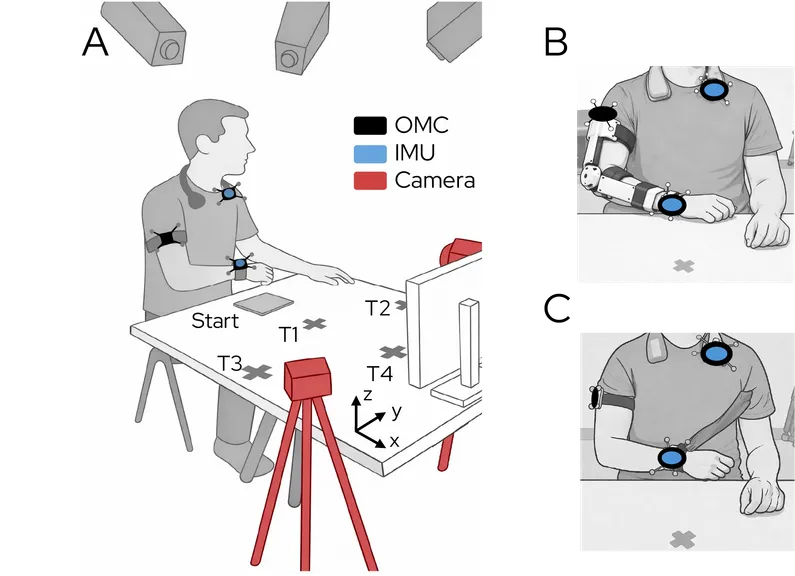
After a stroke, many people regain some arm function but also rely on compensatory movements: instead of fully extending the affected arm, they lean or rotate the trunk to help the hand reach its target. These “compensatory trunk movements” can feel helpful in the moment, but over time they reinforce bad habits that hold back real recovery and can cause secondary pain. Therapists are trained to watch for them, but once a patient leaves the clinic, no one is keeping track.
Our new preprint, led by Jannis Gabler and Clément Lhoste, asks a simple question: can we catch these compensations automatically, in real time, using the smallest possible wearable setup? The answer, it turns out, is yes — with just two small inertial sensors (the kind found in a smartwatch), one worn on the wrist and one on the chest.
We collected synchronized motion-capture, sensor, and video data from ten healthy participants performing a wide range of everyday tasks — reaching, pouring, drinking, sliding objects, manipulating small items — while wearing an elbow brace or a resistance band that mimicked the movement limitations typical of stroke. Physiotherapy-informed video annotations told us, frame by frame, when a compensation was actually happening. We then trained a machine-learning model (XGBoost) to make that same judgment from the sensor data alone.
The two-sensor model performed nearly as well as a full optical motion-capture reference system, correctly identifying compensatory movements with strong accuracy across participants (macro-F1 = 0.80, ROC-AUC > 0.93) and running fast enough for real-time use. Importantly, the model learned to look at the relationship between wrist and trunk motion — not just the trunk alone — which is closer to how a trained therapist actually judges compensation. When we tested the model on preliminary recordings from four patients with neurological conditions, it retained good discriminative ability, though threshold performance varied, pointing to the next step: training on larger and more diverse patient cohorts.
The bigger picture: this work shows that continuous, objective monitoring of movement quality during therapy and daily life is feasible with minimal, unobtrusive hardware. It opens the door to wearable systems that could give patients real-time feedback at home, extend the reach of therapists, and track rehabilitation progress in a way that simply isn’t possible with today’s clinic-bound assessments.
Read the preprint here: Machine Learning for Detecting Compensatory Movements — arXiv:2604.12591
A huge thank you to all the authors for their work on this study: Jannis Gabler, Clément Lhoste, Max Quast, Laura Mayrhuber, Andrea Ronco, Olivier Lambercy, Paulius Viskaitis, and Dane Donegan.